
How to Budget When Your Income Drops: What 2008 Taught Me
How to budget when your income drops, from someone who rebuilt after 2008: find where the money really went, build a runway in micro steps and stay off credit.


I learned how to budget when your income drops the hard way. In 2008, I was $250,000 in debt and our house was underwater. Underwater means you owe more on your mortgage than the house is worth. That was the year of the subprime mortgage crisis. Risky home loans went bad all over the country, the housing market crashed, and home values dropped with it.
We had to sell our first home through a short sale to salvage the rest of our lives. A short sale is when the bank agrees to let you sell the house for less than you owe. It isn’t a foreclosure, and there’s a difference. When you’re underwater, you may have more options than you think, even if none of them feel good, as long as you look at them before it gets too far. We had to restart and rebuild, and it took almost 20 years to get fully back on track.
If 2008 sounds familiar
If you bought a home in the last few years, this may sound closer to home than you’d like. A lot of people paid over the asking price to win a bidding war. Now prices have come down in parts of the country, and about 813,000 homeowners owe more than their homes are worth, according to ICE’s August 2026 Mortgage Monitor. Most of them bought in 2022 or later.
Here’s what I want you to know before anything else: we didn’t live beyond our means. We lived on what we made. Nobody expected that crash, the same way nobody expected COVID. Were there a few bad habits in the middle of it? Probably. But bad habits didn’t shift the whole world.
Everything I learned climbing back out is what I teach now. So if your income just dropped after a layoff, a career change, a divorce or a season you didn’t see coming, start here. And hold on to the line that got me through: if I’ve done something once, I can do it again.
How to budget when your income drops starts with a pause
When you’re figuring out how to budget when your income drops, the first move isn’t a spreadsheet. It’s stopping long enough to reflect on how you got here.
Not to beat yourself up. To see the truth crystal clear. If it isn’t clear, it’s bound to resurface, and you’ll find yourself right back in the same spot a few years from now. My motto works in reverse too: if I failed once and didn’t learn the lesson, I can fail again.
Maybe you put years into your education, your image and how fast you climbed the corporate ladder. Maybe you had strong opinions about how the work could be done better. Then the job disappeared, or the pay stopped covering the life you built.
After all those years you put into getting there, it’s scary not knowing what tomorrow brings. It can feel like all of it went nowhere. It didn’t. The education, the image and the climb are still yours. Whether you made $100,000, $50,000 or $10,000, if you made it once, you can make it again. Last time, someone else built the safety net: the steady paycheck, the 401(k), the benefits. This time, you get to build it yourself.
And without the title, the office and the company name behind you, you get to see who you really are. Remember those strong opinions about how the work could be done better? Were they really good ideas? Now you get to find out. This is your chance to put your money and time behind the ideas you’ve been carrying, starting small, with your runway built first.
Look honestly at the life you’re living
People love to assume everyone in trouble is living beyond their means. Most aren’t. Many are, in fact, living within their means, and then the rug gets pulled.
So part of learning how to budget when your income drops is looking at your lifestyle honestly, without shame. What are you paying for, and why? What does it give you?
It’s not about how you fell. It’s about how you look at the situation and how you bounce back. If you came from struggle and worked your way up, you already know the bottom. Nobody wants to go back, but it’s familiar, and you know how to climb.
Material things can be replaced. Your sanity, your mental health and your wellness can’t. Money stress weighs on your mental health, and you’re not imagining it: 61% of Americans say their financial situation directly affects their mental health, and 62% lost sleep over money in the past month, according to a 2026 Credit Karma survey.
Here’s the part I love. As we get older, many of us realize there was something else we wanted to explore behind the degrees and the titles. A tight season gives you a chance to reset your spending and point that money toward your own growth, whether that’s more education or your creative zone of genius.
Find where the money really went
The numbers don’t lie. We can blame inflation, prices and plenty else, and some of that is real. But behind all of it sits personal responsibility.
10 years ago, we didn’t have 50 apps with 50 subscriptions. Today the average American spends $111 a month on subscriptions, up 23% in a year, and wastes about $252 a year on ones they don’t use, according to CNET’s 2026 survey. Most of us don’t even know how much we pay for subscriptions every month. In a West Monroe survey of 2,500 people in the US, 89% guessed lower than what they actually spend, and 2 out of 3 of them were off by more than $200 a month.
Knowing how to budget when your income drops means knowing that number. Here’s how fast it adds up at 2026 US prices, with ad free streaming plans:
| Subscriptions | Monthly |
|---|---|
| Netflix, Disney+, Hulu and HBO Max | $81.46 |
| Peacock, Paramount+ and Apple TV | $48.97 |
| YouTube Premium and Spotify | $28.98 |
| Amazon Prime with ad free Prime Video | $19.98 |
| ChatGPT Plus | $20.00 |
| Walmart+ | $12.95 |
| DashPass, Uber One and Instacart+ | $29.97 |
| Total | $242.31 |
Add a gym membership and an app or two, and it passes $300 a month. That’s $3,600 a year.
This isn’t about giving everything up forever. It’s about adjusting in a tight season. When you’re willing to truly see what’s in front of you, you’ll see how far $300 can go: a bill paid off faster, a class you’ve put off, the first deposit toward your runway.
Build a 12 month runway in micro steps
Most people will tell you to set aside 6 months of expenses. I’m telling you 12. The cost of living keeps climbing, the job market feels uncertain and inflation shows up on every receipt. You might not like that number, but the reality is what it is, and you can get there in micro steps.
You won’t be alone in starting small. When Bankrate asked Americans how they’d pay for a surprise $1,000 bill, like an emergency room visit or a car repair, only 30% said they’d use their savings. Everyone else would have to find the money some other way, according to Bankrate’s 2026 Emergency Savings Report. And only 27% have enough saved to cover 6 months of expenses.
Here’s what a micro step looks like. Open a separate savings account just for your runway, so it isn’t sitting where you can spend it. Then set up an automatic transfer every payday, even if it’s $25. When you cancel a subscription, move that same amount into the runway instead. Watching it grow is what keeps you going.
Two ways to budget when your income drops
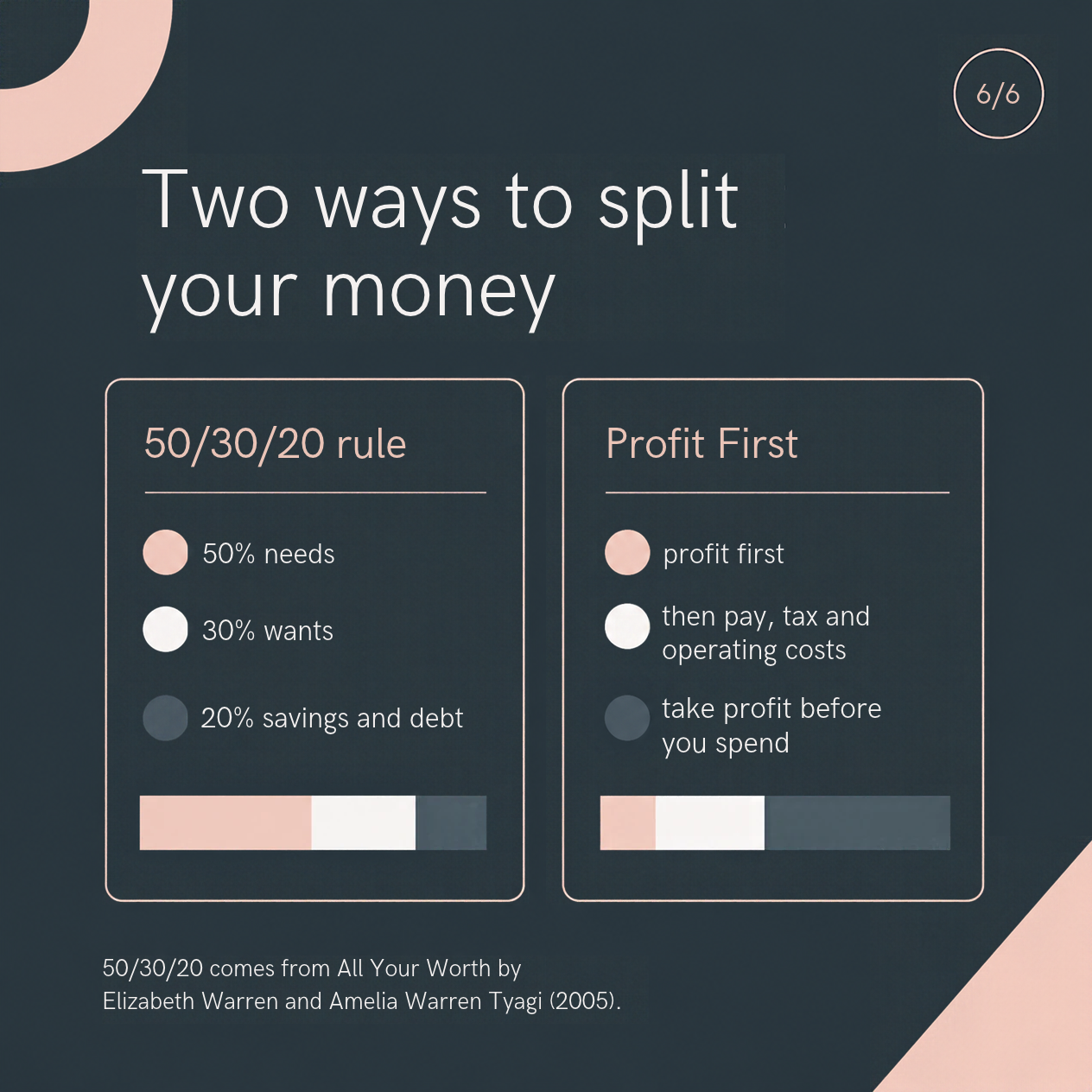
Two simple ways to split income can help you decide where each dollar goes:
| 50/30/20 rule | Profit First | |
|---|---|---|
| Built for | A household paycheck | Business owners and anyone with self employment income |
| The split | 50% needs, 30% wants, 20% savings and debt | Profit, owner’s pay, taxes and expenses, each in its own account |
| The order | Divide the whole paycheck at once | Pay yourself first, then run on what’s left |
| When income drops | The split bends when needs take more than half | Start where you are and move toward the targets 1% at a time |
The 50/30/20 rule comes from All Your Worth, the 2005 book by Elizabeth Warren and Amelia Warren Tyagi. Profit First comes from Mike Michalowicz and was built for business income. Both share one idea most people never hear early enough: take care of your future before your spending. That idea, paying yourself first, deserves its own article, and it’s coming.
Pick the one that fits how you earn. Then move 1% at a time. That’s how to budget when your income drops without trying to fix everything in one month. Micro steps still count.
How to budget when your income drops without leaning on credit
When money gets tight, the card feels like a bridge. It isn’t. It’s borrowing money you don’t have, and the bridge keeps getting longer.
Sometimes you have to use it for food. I won’t pretend otherwise. You’re not alone there either: 53% of Americans carry credit card balances to cover essential living expenses, and 25% carry them for 6 months or longer, according to a 2026 Achieve survey.
That’s exactly where the reality check comes in. In hard seasons, I see more wasteful spending, not less, because nobody wants to face what’s in front of them. We call it a self care moment. All of it catches up.
This isn’t about being frugal. It’s about being realistic. Card companies will keep extending your credit. If you lean on cards to bridge the gap, you can end up in a trap you can’t climb out of. Be honest with yourself about which purchases are survival and which are avoidance.
Who gets caught off guard
The people I see trapped most often didn’t do anything reckless. They trusted that the money would keep coming the way it always had, from a spouse, a steady paycheck or a partner who handled the bills, and nobody ever showed them how to budget when their income drops.
A stay at home parent who gave years to raising a family, holds a college degree, never worked in between, and suddenly faces a divorce.
A spouse who never worked outside the home when the breadwinner dies. The house may pass to the surviving spouse, but the mortgage still has to be paid, there’s no life insurance, and sometimes nobody knows what’s in the bank account or how to get to it.
A spouse who works hard, hands the paycheck to the other spouse every month and stays out of the finances, because they’d rather earn it than manage it. Then they lose the job and find out the money isn’t there. I see this one a lot.
That last one isn’t mismanagement. It’s a lack of communication. Everybody’s on the go. People blame keeping up with the Joneses, but most of the time it’s bad habits and a lack of awareness. Sit down together and look at the whole picture before a crisis forces you to.
If the second one hits close to home, read term vs whole life insurance next.
More than one income is a safety net
Take everything you’ve learned over the years and find the thing that lights you up most. Then see if a job can scratch that itch.
In the meantime, a side hustle is normal. I believe in always having more than one income. It doesn’t matter how it comes, as long as you have a safety net. In my own seasons, I reached more of my goals with steady income coming in while I got an idea off the ground.
A second income is one of the strongest answers to how to budget when your income drops, and plenty of people already lean on one. 27% of US adults have a side hustle, and 35% of them use it for regular living expenses, according to Bankrate’s 2025 survey.
If you feel behind
If you’re 35 and you feel behind, this is something I hear so often. Maybe you thought you’d be married by now, or have kids, or be making more. It can feel like you’re racing against time. If you’re 45 or 55, you’re racing against time too, just in a different way: the years you have left to build before you stop working. Either way, feeling behind isn’t always about the money. Sometimes it’s about the dream you never went after.
Social media makes it look like everyone is ahead of you. That’s a highlight reel. Many people are going through the same thing, or worse. You just don’t see the real picture, or what’s really coming in and going out.
That’s why I do the research when I write these articles for you. I don’t want you taking my word for it based on my opinions, or only on my own story, which could feel one sided. I’m giving you a snapshot of what’s really happening across the United States. But you have to be the one willing to face it. Knowing you’re not alone isn’t an excuse to keep going the way you’re going, and it isn’t a reason to give up because everyone’s in the same boat.
So if life pulled the rug out from under you, what will you do with it? Will you sit and fold, or be the victorious person I know you can be? Take every lesson, including how to budget when your income drops, and make something of it, for yourself and for the people who rely on you, whether they came before you or after.
Your next step on how to budget when your income drops
If you grew up making a way out of no way, you already know how to do this. How to budget when your income drops comes down to three moves: reflect on how you got here, find where the money really went, and build your runway one micro step at a time.
Want to know where your money story stands right now? Take the quiz. A few questions, and you’ll know which next step fits you.
Not ready? Start with my free guide, The Questions Nobody Told You to Ask →
A friendly reminder: I’m sharing what worked for me and what I’ve learned walking with others through it. I can’t promise you’ll get the same results, because no two situations are the same. What I can promise is honest education and a clear next step. What you do with it is up to you, and I’ll be cheering you on.